

Math-U-See vs Saxon vs Singapore: Which Math Fits Which Kid
Some links in this post are affiliate links. If you buy through one, First Homeschool earns a small commission at no extra cost to you — it helps keep guides like this free and the used shelf stocked.
You've narrowed the math decision to three names everyone keeps recommending, and they all sound good. The problem is that Math-U-See, Saxon, and Singapore teach in three different ways, and the wrong way for your particular kid is what turns math into a daily fight.
Here's the short answer. There's no single best homeschool math curriculum. Math-U-See is mastery math: one concept at a time, taught with colored blocks and a video, until it sticks. Saxon is spiral math: a small new idea every day, then weeks of mixed review. Singapore is conceptual math: pictures and bar models that show why the arithmetic works. Pick by how your kid learns and how much you want to teach, then buy the level the placement test says, not the grade on the cover.
I taught special education and ran a school before I opened a used curriculum store, so I've watched all three of these work and all three of these fail. It was never the book's fault. It was the match.
In short
- Math-U-See fits kids who need to touch the math and parents who want a video to do the teaching.
- Saxon fits kids who forget without daily review and parents who want a textbook that runs itself from grade 4 up.
- Singapore fits kids who ask "why" and parents willing to sit at the table with a teacher's guide.
- All three publishers offer free placement tests. Use them.
- Used copies run a fraction of new, but editions matter. Check before you buy.

What's the difference between mastery, spiral, and conceptual math?
Mastery math teaches one skill until the child owns it, then moves on and rarely circles back. Spiral math introduces a small new idea each lesson and keeps every old idea in daily practice for months. Conceptual math cares less about the order and more about the picture in the child's head; it wants the kid to see why 34 minus 18 works before drilling it.
Every program borrows a little from the others. Math-U-See has review pages. Saxon has manipulatives in K through 3. Singapore's U.S. Edition calls its own progression a spiral. But the center of gravity is different, and that's what your kid will feel by week three.
| Program | Approach | Who teaches | Fits best | Skip it if |
|---|---|---|---|---|
| Math-U-See | Mastery | Video does most of it; parent checks with the blocks | Hands-on learners, kids behind in one area, math anxiety | Your kid forgets skills the month after learning them |
| Saxon | Spiral | Parent-led K–3; textbook self-teaches from 5/4 up | Kids who need constant review, independent readers, big families | Your kid melts down at 30 mixed problems a day |
| Singapore | Conceptual | Parent teaches from the Home Instructor's Guide | Kids who ask why, strong readers, parents who like math | You need open-and-go, or math scares you too |
Math-U-See: mastery, blocks, and a video that teaches
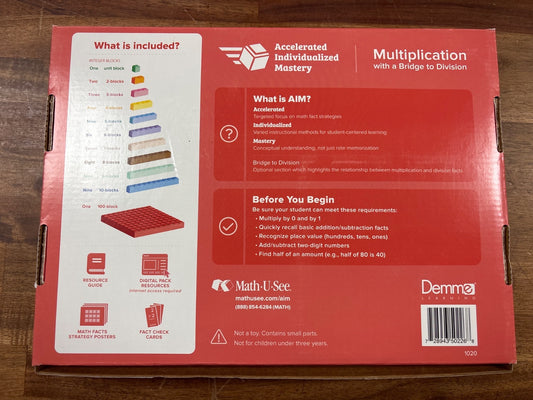
Math-U-See is a mastery program built around a set of colored integer blocks and a short video lesson for every lesson (Alpha has 30, plus two on telling time). The levels carry Greek names instead of grade numbers (Primer, Alpha, Beta, Gamma, on up through the algebra levels), on purpose: Alpha is single-digit addition and subtraction, Gamma is multiplication, and a fourth grader who never learned to multiply belongs in Gamma, not "4th grade." The publisher lists four steps (prepare, present, practice, progress). The second one is the whole program: the child builds the problem with blocks, writes it, and explains it back.
That teach-it-back step is straight out of a good special-education classroom. In my special-education years, the kids who could explain regrouping with blocks were the ones who stopped making regrouping errors. The kids who'd only ever seen it on paper kept guessing.
Who it fits: kids who need to touch the math, kids with a specific gap (fractions, multiplication) who need to camp there for a while, kids with math anxiety who do better with one thing at a time, and parents who want the video to carry the teaching.
Who it doesn't: kids who forget a skill the month after they master it. Math-U-See's built-in review is thin compared with Saxon, and you'll need to add fact practice yourself. It's also light on word problems in the early levels. And a kid who finds blocks babyish by age nine will resist.

Saxon Math: spiral, incremental, and a lot of review
Saxon calls its method incremental development with distributed practice: each lesson adds one small increment, and the problem set that follows mixes the new skill with everything taught so far. The publisher's own description is that cumulative practice "cover[s] ideas from earlier lessons to ensure students retain and make connections between concepts." That's the whole pitch. Nothing is allowed to fade.
The program changes shape at grade 4. Saxon K through 3 is scripted for the parent, with a teacher's manual and manipulatives you supply yourself. From Math 5/4 upward it becomes a textbook (5/4 has 120 lessons), a tests-and-worksheets book, and a solutions manual, and a kid who reads well can run it alone. Video help exists if you want it: the older DIVE CDs, the Saxon Teacher CDs, and subscription lessons from Nicole the Math Lady.
Most of the Saxon that comes across my counter is the middle-grade run, 5/4 through Algebra 1/2, and most of it comes back from families whose kid did fine. It's also the program I see abandoned the most, always for the same reason: thirty mixed problems a day, every day, for a kid who already knew twenty-five of them.
Who it fits: kids who forget without review, kids who like knowing exactly what today looks like, and independent readers from about fourth grade. Also parents with several children who need one of them to self-teach.
Who it doesn't: kids who hate repetition, kids who process slowly and need an hour for the problem set, and kids who need to see the big picture before the pieces. Saxon shows the pieces first. If your kid asks "but why does that work?" and the answer "it just does" starts a fight, look at Singapore instead.

Singapore Math: conceptual, bar models, and five editions
Singapore Math teaches with the concrete-pictorial-abstract sequence: the child handles objects first, then works with pictures of them, then moves to plain numbers. The signature tool is the bar model, a rectangle diagram that turns a word problem into something you can see. Lessons are short. The textbook is thin. Most of the teaching happens out loud, from the Home Instructor's Guide, with you at the table.
The catch is editions. There are five: the original U.S. Edition, the Standards version (aligned to California), the Common Core version (which the publisher now lists as a sunset product), the 2022 revision with new content and structure, and Dimensions Math, the publisher's current flagship for PK through 8. The publisher says plainly that components "are not interchangeable across editions." A 2022 workbook will not line up with a U.S. Edition textbook. Buy the whole level from one series.
Nearly every Singapore book on my used shelf is U.S. Edition, and that's fine. It's the edition with the shortest lessons, the publisher still sells it new, and it still has a free placement test.
Who it fits: kids who ask why, quick kids who get bored with drill, and strong readers. On the parent side: people who like math, or who'll learn it a page ahead of the child.
Who it doesn't: parents who need open-and-go. Singapore is the most teacher-intensive of the three. It also assumes fact fluency it doesn't drill, so a kid who hasn't memorized facts will stall in 2B or 3A. And if math scares you, the mental-math strategies will feel foreign. That's not a character flaw; it's a reason to pick Saxon or Math-U-See.

Which homeschool math curriculum fits which kid?
Forget the reviews for a minute and think about your actual child. Which of these sounds like them?
The kid who has to touch it
Math-U-See first. The blocks aren't a gimmick; they're the lesson. Saxon K–3 also uses manipulatives, but by 5/4 it's paper. Singapore uses concrete objects early, then leans on pictures. If your kid still counts on fingers at eight, that's information, not a problem, and it points at blocks.
The kid who forgets
Saxon. Some kids learn a skill on Monday and lose it by the following Monday unless it keeps showing up, and Saxon is built for exactly that. If you love Math-U-See's teaching but your kid forgets, keep Math-U-See and add a daily fact drill. Don't switch programs to fix a review problem.
The kid who hates repetition
Singapore, or Math-U-See. Quick kids find Saxon's mixed practice insulting, and they're half right. You can trim Saxon to odd-numbered problems, but if you're trimming every day, you bought the wrong book.
The kid with math anxiety
Math-U-See, usually. One concept, a calm video, blocks that make the answer visible. Start a level below where you think they are. The first month should feel easy; that's the point. Singapore can work too if you slow down, but its mental-math strategies can feel like one more thing to be wrong about.
The parent who needs open-and-go
Math-U-See for the early years, Saxon from 5/4 up. Both run without you preparing anything. Singapore doesn't. Be honest about this one. The best curriculum is the one that still gets done in February.
The parent who wants to teach
Singapore. If you'd enjoy sitting down with a Home Instructor's Guide and a whiteboard, it's the richest of the three. RightStart Math, an abacus-based program we don't stock, is the other one families in this group ask me about; it's more parent-led than Singapore, not less.
What does each one cost, used versus new?
Prices in this post were checked in September 2026; publishers change them, so verify before you buy.
Math-U-See is the expensive entry. The Alpha Set from the publisher (instruction manual, student workbook, tests, the 133-piece integer block kit, and a one-year video subscription) is $220.12 new (check current pricing). The blocks are a one-time buy that carries through Algebra, so the second level is cheaper. Used, the Math-U-See instruction manuals on my shelf run about $5 to $9, manual-plus-tests sets about $19, and the algebra/decimal insert kits $18 to $29. The student workbook is consumable, so plan on buying that new.
Saxon is sold through retailers, not direct, and the spread is wide. The Math 5/4 Homeschool Kit, 3rd edition (text, tests and worksheets, solutions manual) was $117.95 at Rainbow Resource, $133.29 at Christianbook, and $201.45 at Sonlight the week I checked, against a list price of $323.13 (check current pricing). Used, a middle-grade Saxon textbook runs $14 to $21 on my shelf, and an Algebra 1 4th edition text about $54. Only the tests book is consumable.
Singapore is cheap per book and adds up by the piece. A U.S. Edition semester is a $16.90 textbook, a $16.50 workbook, and a $20.00 Home Instructor's Guide, times two semesters a year (check current pricing). Dimensions Math 2A is $14.50 for the textbook, $14.50 for the workbook, and $22.50 for the Home Instructor's Guide (check current pricing). Used U.S. Edition textbooks on my shelf are $3.53 to $10.66 and the guides $7 to $11. Workbooks are consumable; buy those new.
Buying used: the edition traps to know about
Used math is one of the best deals in homeschooling, and it's also where I see the most returns. Three traps.
Saxon. The textbook, the tests, and the solutions manual must match. The publisher no longer prints answer keys or tests for older printings, so a 2nd edition Math 76 text is a great buy only if you can find its matching key, or you're willing to check the work yourself. Watch the Algebra line too: the 4th edition Algebra 1 is a different book from the 3rd, not a reprint.
Math-U-See. Good news here. The publisher says an older instruction manual "is compatible with a current Student Workbook," which is why the 2004 and 2010 manuals on my shelf are worth buying. The one exception is Algebra 1: the older manual stops at lesson 34 and the current workbook has 35, and the publisher recommends buying a current instructor pack instead. Older sets also ship fewer blocks.
Singapore. Match the edition on every piece. U.S. Edition with U.S. Edition, Dimensions with Dimensions. If you can't tell from the cover, the ISBN on the publisher's site will.
Does your kid need to be placed before you buy any of this? Yes. Math-U-See has a placement tool at placement.mathusee.com, Singapore posts free tests for every edition, and Saxon's test is on retailer sites like Sonlight. Singapore's own advice is that a second grader "may be best served by starting with 1A or 1B." I'd say that about all three.
Frequently asked questions
Which is better for a struggling learner, Math-U-See or Saxon?
It depends on the struggle. A kid who doesn't understand the concept does better with Math-U-See's blocks and one-topic lessons. A kid who understands but forgets does better with Saxon's daily mixed review. If it's both, start with Math-U-See a level low and add five minutes of fact drill each day.
Can I switch from Saxon to Singapore Math mid-year?
You can, but take the placement test first and expect to land a level lower than the grade number. The publisher says that's common when moving from another program. Singapore also assumes memorized facts, so keep some drill going. Switching from Singapore to Saxon is usually easier than the reverse.
Do I need the Math-U-See blocks, or can I use base-ten blocks?
You need them for the early levels. The videos and the instruction manual refer to the specific colors, and the blocks are how the child is meant to build and explain each problem. Base-ten blocks cover some of it but not the color-coded units. The kit is a one-time purchase that lasts through Algebra.
Which Singapore Math edition should I buy?
For a used buyer, the U.S. Edition: shortest lessons, still in print, still has a free placement test, and it's the edition most used shelves carry. For a new buyer who wants the fullest teacher support, Dimensions Math. Whichever you pick, buy every component in that one edition; they don't mix.
Is an older Saxon edition okay to use?
The teaching is the same. The trouble is answers: the publisher no longer prints tests or answer keys for older editions, so you need the matching key with the book or the willingness to check work yourself. If you find a complete older set, it's a fine buy. A text alone is a gamble.
The short version
Hands-on kid or anxious kid: Math-U-See. Forgetful kid or self-teaching kid: Saxon. Curious kid with a parent who'll teach: Singapore. Take the placement test, buy one level low, and match editions before you spend a dollar on used.
Sources
- Math-U-See, “Alpha” (level contents, four-step method, 133-piece block kit, placement tool; checked September 2026)
- Demme Learning Store, “Alpha Set” (new price and set contents; checked September 2026)
- Demme Learning, “Version Compatibility” (older manuals with current workbooks, Algebra 1 exception, block counts; checked September 2026)
- HMH, “Saxon Math” (incremental development, distributed practice, cumulative assessment; checked September 2026)
- Sonlight, “Saxon Math” (K–3 vs 5/4 format, manipulatives not supplied, placement test; checked September 2026)
- Rainbow Resource, “Saxon Math 5/4 Homeschool Kit (3rd Edition)” (price, kit contents, 120 lessons; checked September 2026)
- Christianbook, “Saxon Math 5/4 Homeschool Kit, 3rd Edition” (price and list price; checked September 2026)
- Sonlight, “Saxon Math 5/4 Homeschool Kit (3rd edition)” (price; checked September 2026)
- Lamp Post Homeschool, “Saxon Math (Older Editions)” (older-edition answer keys and tests no longer published; checked September 2026)
- Singapore Math Inc., “Program Comparison” (editions, Common Core sunset, not interchangeable; checked September 2026)
- Singapore Math Inc., “Primary Mathematics U.S. Edition Textbook 2A” (U.S. Edition prices, CPA approach; checked September 2026)
- Singapore Math Inc., “Dimensions Math Textbook 2A” (Dimensions prices; checked September 2026)
- Singapore Math Inc., “Placement Tests” (free tests by edition, start-lower advice; checked September 2026)







Comments